This maintenance guide comes from years of hands-on customer support for robot vacuum owners, now published here for anyone to use rather than kept inside one support inbox. Several of the models and parts named below link out to Plus.Parts®, the maintenance parts store run by the same company behind this site, and that is also where much of the experience behind this guide comes from.
The Roborock Saros series is built around a lidar-less chassis that relies on structured-light sensors, optical cameras, and AI-driven obstacle recognition to navigate without a dome turret. Each model in the range, from the Saros 10 and Saros 10R
 through to the Saros 20, Saros 20X, and Saros Z70
 , combines suction of 20,000 Pa or higher with a multifunctional dock that washes mop pads at 80°C and dries them with hot air. The range has since widened to include the Saros 20 Sonic
 and Saros 20 Sonic Complete
 , both built on the same platform. That architecture means the filter, brush, mop pads, and dock components all work harder than on any previous Roborock generation. This guide covers the complete maintenance schedule for the Roborock Saros series, explains how each named model differs, and links the specific dust bag, mop pad, or filter each model uses rather than only the full maintenance set.
Why Roborock Saros series robots need more frequent maintenance
High suction loads the filter faster than mid-range robots
At 20,000 Pa and above, the Saros platform pulls significantly more air through the HEPA filter per session than a typical 6,000 to 8,000 Pa robot. The filter captures fine particulate that lower-powered vacuums leave behind on the floor, which is part of why the Saros 10, Saros 20, and Saros 20X leave measurably cleaner floor profiles per run. The filter medium darkens faster at higher suction rates. A filter that has shifted from white to mid-grey is no longer operating at its rated airflow and causes the brushless motor to compensate with extra current, adding heat and wear. Replacing on schedule rather than on visible cues alone keeps the suction tier intact across the robot’s full working life.
The low-profile chassis puts obstacle sensors closer to floor dust
Saros robots omit the traditional lidar turret and rely on forward-facing optical sensors, structured-light arrays, and AI camera modules positioned in the leading edge of the body. On the Saros 10, the chassis sits at roughly 7.98 cm. These sensors are closer to the dust layer kicked up during cleaning than on a taller robot. Fine dust settling on sensor windows causes false obstacle readings, detours around clear floor space, and in some cases a refusal to leave the dock. A weekly wipe of the sensor windows with a dry microfibre cloth is part of Saros maintenance in a way it is not on dome-lidar predecessors.
The AdaptiLift chassis and Flexi-Arm side brush add moving parts
The Saros 10 features an AdaptiLift chassis that raises the body up to 10 mm to cross thresholds. The Saros 10R, Saros 20, and Saros 20X use a Flexi-Arm side brush that extends outward to reach walls and corners. Each mechanism has pivot joints and guide rails that collect hair and floor grit during normal use. A stiff or partially blocked arm does not reach full travel, meaning wall edges are missed or the robot high-centres on a doorway it previously crossed without issue. Monthly attention to these rails keeps the mechanisms moving freely.
The heated dock wash creates limescale risk in hard-water areas
The multifunctional docks across the Saros range wash mop pads at 80°C, with hot-air drying following the wash cycle. At that temperature, mineral deposits from tap water precipitate onto the dock spray nozzles faster than on a cold-wash dock. A partially blocked nozzle produces uneven water distribution across the mop pad, leaving one area not properly rinsed. Monthly nozzle wiping prevents build-up. In hard-water regions, every two to three weeks is a more appropriate interval to prevent limescale from accumulating to the point where descaling rather than simple wiping is required.
Models in this series compared
| Model | Suction | Mop system | Brush type | Dock |
|---|---|---|---|---|
| Saros 10 |
22,000 Pa | VibraRise 3.0 flat liftable | Single DuoRoller | Multifunctional, 80°C wash, hot-air dry |
| Saros 10R |
20,000 Pa | Retractable flat | DuoDivide dual-roller anti-tangle | Multifunctional, 80°C wash, hot-air dry |
| Saros 20 |
25,000 Pa | Retractable flat | DuoDivide dual-roller anti-tangle | Multifunctional, 80°C wash, hot-air dry |
| Saros 20X |
25,000 Pa | Retractable flat with extended reach | DuoDivide dual-roller anti-tangle | Multifunctional, 80°C wash, hot-air dry |
| Saros Z70 |
22,000 Pa | VibraRise flat liftable | Single DuoRoller | Multifunctional, 80°C wash, OmniGrip robotic arm |
Specifications for the Saros 20 Sonic and Saros 20 Sonic Complete are not yet independently verified against Roborock documentation, so they are intentionally left out of the comparison table above rather than estimated. What is confirmed is compatibility: both use the same dock dust bag as the standard Saros 20, which places them firmly within this platform family.
22,000 Pa models with single DuoRoller brush
The Saros 10 and Saros Z70 share the single-roller DuoRoller brush and the VibraRise flat liftable mop module. At 22,000 Pa, the filter loads roughly twice as fast as a 10,000 Pa robot, which shortens the filter replacement cycle to two to three months under daily use. The flat liftable mop means pad wear is uniform across the full surface rather than concentrated on a rotating edge. The Saros Z70 adds the OmniGrip robotic arm that stows above the dustbin; dock dustbag monitoring is more important on this model because a full bag interferes with arm clearance during the self-empty cycle. The market code RRE0R50 is a regional SKU for the Saros Z70 and shares identical maintenance intervals.
DuoDivide dual-roller models at 20,000 to 25,000 Pa
The Saros 10R, Saros 20, and Saros 20X use the DuoDivide dual-roller main brush, designed so the two counter-rotating rollers divide hair and long fibres between them before either can wrap into a single tangle. The maintenance trade-off is that there are now two rollers, two sets of end caps, and a mid-roll divider channel to clean at every service. Skipping the divider channel clear allows compressed fibre to build up and eventually binds both rollers together. The Saros 20 and Saros 20X push suction to 25,000 Pa, which shortens the filter replacement cycle to every two months. Market-specific SKU codes for models in this group include the S10R52-00 (Saros 10R), S91COP, S20X52-00 (Saros 20X), RRE0VIS, RRE0VSC, RRE0VSP, and RRE0CPS; all share identical consumables and maintenance intervals with their named counterparts.
Replacement parts and service intervals
Main brush roll
Clean every one to two weeks and replace every five to seven months under daily residential use. For the Saros 10 and Saros Z70, cleaning means cutting wrapped hair along the full roll length with scissors, clearing both end cap bearing holes with a toothpick, and removing debris from the brush chamber. A roll that does not spin freely by hand after cleaning is a common precursor to a brush stall error on this platform. For the Saros 10R, Saros 20, and Saros 20X with the DuoDivide dual-roller system, apply the same steps to both rollers and clear the central divider channel at every service. The channel accumulates compressed fibre that is not visible from the outside; skipping it allows the divider mechanism to bind both rollers simultaneously over subsequent sessions. No model in the range currently has the main brush roll listed as a separate single item, so each model name above links to its maintenance set, which includes the brush roll as one of its components.
HEPA filter
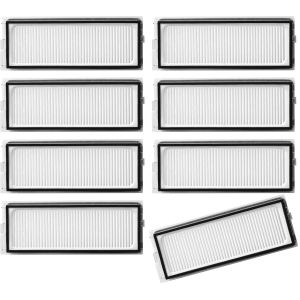
Clean every one to two weeks by tapping all four sides of the filter frame firmly over a waste bin. Do not wash the filter with water unless the product documentation specifically confirms it is washable, as washing degrades the HEPA medium even if the filter appears undamaged afterward. The visual replacement indicator is a shift from white to a consistent mid-grey. On the Saros 10 and Saros 10R, replace every two to three months; neither has an individual filter listed yet, so each links to its maintenance set, which includes the filter. The Saros Z70 filter follows the same two-to-three-month interval and is available as a single item, which is the more economical choice for households replacing only the filter rather than the full maintenance set. On the Saros 20 and Saros 20X at 25,000 Pa, replace every two months; these two also have no individual filter listed yet, so their maintenance set link covers it. Higher airflow per session shortens the effective service life regardless of how often the filter is tapped clean.
Battery
The Saros series uses a high-capacity lithium battery to support the power demands of 20,000 Pa and above suction alongside the heated dock cleaning cycles. Under normal residential use with daily sessions, the battery typically delivers reliable performance for two to three years before capacity begins to decline noticeably. The charging contacts on the underside of the robot and on the dock should be wiped monthly with a dry cloth; oxidation on these contacts causes incomplete charging cycles that are often mistaken for battery degradation. The signal that the battery needs replacement is a consistent reduction in maximum runtime per charge after a full overnight charge cycle, or a robot that returns to dock significantly earlier than it used to on the same floor plan. At that point, the battery should be replaced rather than waiting for further decline, as operating at low capacity stresses the management circuitry.
Mop pads
The dock’s 80°C wash cycle handles daily hygiene, but it does not reverse physical degradation of the pad fibres. Inspect at eight weeks and replace when surface texture has reduced, the pad feels stiff after washing, or persistent discolouration is present. The Saros 10R , Saros 20, and Saros Z70 are all available as single items for households that only need pad replacement rather than the full set. A pad past its effective interval redistributes soiling across the floor rather than removing it. On the Saros 20X, the extended-reach mop travel arc accelerates outer-edge pad wear relative to the inner area because of the longer travel arc; inspect at six weeks on this model specifically.
Side brush
Inspect the side brush post weekly. Hair and thread wrap around the base and apply quiet strain to the brush motor over time. Clear any accumulation with a toothpick or small scissors. Replace every three to six months, sooner in homes with pets or long hair. On the Saros 10R, Saros 20, and Saros 20X, the Flexi-Arm extending side brush adds a rail that needs wiping monthly; a rail with grit develops resistance and prevents the brush from reaching full extension along walls, reducing edge cleaning coverage measurably. No individual side brush is listed for these models yet, so each links to its maintenance set instead.
Dock dustbag
Roborock Saros multifunctional docks use sealed dust bags. Under daily use with auto-empty after every session, the bag accumulates material faster than a manually-emptied robot’s dustbin. A full bag means the next auto-empty cycle fails mid-transfer, which leaves the robot’s internal dustbin unable to accept new material for the following run. Replace every three to five weeks as a realistic daily-use cadence. The dust bag is available as a single item for every model in the range: the Saros 10, Saros 10R, Saros 20, Saros 20X, and Saros Z70 use the identical part, as do the Saros 20 Sonic and Saros 20 Sonic Complete. On the Saros Z70, a full bag also restricts the OmniGrip arm’s movement during self-empty; monitor the dock indicator more attentively on this model compared to the rest of the range.
Dock dirty-water tank and spray nozzles
Empty and rinse the dirty-water tank every two to three days. The Saros dock runs a mop wash after every session, filling the tank faster than on robots that require manual mop cleaning. Wipe the dock spray nozzles monthly, or every two to three weeks in hard-water regions. If mop pads return with one side visibly less clean than the other, a partially blocked nozzle is the first place to check. The hot-air dryer intake vents at the base of the dock benefit from a monthly wipe as well; accumulated lint reduces dry-cycle performance and can leave pads slightly damp after what appears to be a completed drying cycle.
Sensor windows
Because the Saros platform uses optical and structured-light sensors rather than rotating lidar, sensor hygiene is part of the weekly maintenance routine. Wipe the forward-facing camera window, the structured-light emitter window, and the underside cliff sensors with a dry microfibre cloth every week. A smudged or dusty sensor window causes false obstacle detections, unnecessary detours, and in some cases a refusal to leave the dock. This applies to every model in the Saros range: the Saros 10, Saros 10R, Saros 20, Saros 20X, and Saros Z70.
Maintenance at a glance
| Component | Clean | Replace |
|---|---|---|
| Main brush roll (incl. DuoDivide divider channel where present) | Every one to two weeks | Every five to seven months |
| HEPA filter | Every one to two weeks | Every two to three months (every two months on Saros 20 / 20X) |
| Mop pads | Auto-washed by dock | Inspect at eight weeks (six weeks on Saros 20X) |
| Side brush | Post weekly; Flexi-Arm rail monthly | Every three to six months |
| Dock dustbag | — | Every three to five weeks (Saros 20 Sonic and Sonic Complete share the Saros 20 interval) |
| Dock dirty-water tank | Every two to three days | — |
| Dock spray nozzles | Monthly | — |
| Sensor windows | Weekly | — |
| AdaptiLift pivot rails (Saros 10 only) | Monthly | — |
Common problems and their maintenance causes
Robot refuses to leave the dock or detours around empty floor
Because Saros navigation relies on forward-facing optical and structured-light sensors rather than a rotating lidar, a dusty or smudged sensor window produces false obstacle detections. Wipe the leading-edge camera and structured-light windows with a dry microfibre cloth. If the issue persists, check the cliff sensors on the underside for fine dust accumulation. This is a distinctly Saros-family symptom that owners transitioning from dome-lidar Roborock models have not encountered before.
Suction noticeably weaker than usual
At 20,000 Pa and above, a clogged HEPA filter produces a distinct performance drop rather than a gradual one. Remove and inspect the filter first; if it has shifted from white to grey, replace it. If the filter looks clean, check the brush roll area and the suction inlet port inside the dustbin for a blockage. On the Saros 10R, Saros 20, and Saros 20X, also confirm that the central divider channel between the two rollers is clear, as a packed channel reduces airflow through the roll housing and compounds any filter restriction already present.
Mop pads returning with one side visibly dirtier
The dock spray nozzle has partial limescale blockage, producing uneven water distribution across the pad during the wash cycle. Wipe the nozzle area and descale with a dilute citric acid solution if build-up is visible. If the nozzle is clear and the uneven pattern persists, the pad has embedded soiling beyond what the wash cycle can remove and should be replaced. Running the self-cleaning dock cycle from the Roborock app after descaling confirms that wash coverage has been restored before the next session.
Robot high-centres on a threshold it previously crossed
On the Saros 10, the AdaptiLift chassis raises the body up to 10 mm to clear thresholds. The pivot rails that allow the lift motion collect hair and grit over time, and a partially obstructed rail does not reach full lift. Wipe both pivot rails and confirm the chassis moves freely through its full range by hand with the robot powered off. If wiping does not restore full motion, the rail may need replacing rather than cleaning alone. Other Saros models do not feature AdaptiLift and will not high-centre on thresholds for this reason.
Hair wrap on the main brush despite the anti-tangle design
On the Saros 10R, Saros 20, and Saros 20X, the DuoDivide divider channel is the mechanism that prevents single-roll wrap. When the channel is loaded with compressed fibre, the divider no longer intercepts hair effectively and wrapping occurs across both rollers simultaneously. Remove both rollers, clear the divider channel thoroughly, clean both sets of end caps, and confirm both rollers spin freely by hand before reinstalling. A recurring wrap issue after cleaning usually means the service interval is too long for the household’s shed rate, not a fault with the anti-tangle design.
Auto-empty not completing or dustbin remains full after docking
The dock bag is full, or the suction channel between the dock and the robot’s dustbin port is blocked by caked dust. Replace the bag first. If the problem continues, wipe the docking port at the base of the robot and the port seal clean. Fine dust accumulates around the port from repeated docking cycles and breaks the seal needed for effective auto-emptying. On the Saros Z70, also confirm the OmniGrip arm is fully stowed; an arm that has not retracted into its cradle can block the auto-empty chute and prevent the cycle from completing.
Persistent damp smell from mop pads after dock wash
The hot-air dryer vents at the base of the dock are partially blocked by accumulated lint, reducing dry-cycle airflow. Wipe the vent grilles with a dry cloth. If the smell persists despite clear vents, the pad has reached the end of its absorbent service life and should be replaced; the 80°C wash removes surface soiling but cannot restore degraded fibre absorbency. This symptom is most common on the Saros 20 and Saros 20X where the high-frequency dock wash cycles accumulate thermal stress on the pad fibres faster than on models with fewer daily sessions.
What consistent maintenance protects over time
At this performance tier, every consumable works harder than on a standard robot. The HEPA filter processes more air per session, the dock washes mop pads daily at 80°C, the auto-empty system runs on every docking cycle, and the AdaptiLift or Flexi-Arm mechanisms cycle on every threshold crossing or wall approach. Each subsystem has a wear rate that responds directly to whether the preceding consumable is in good condition. A clogged filter strains the motor. An overloaded dock bag prevents the auto-empty from completing. A stiff lift rail risks threshold high-centring and, over time, structural strain on the chassis. Staying on the maintenance schedule across all components keeps each subsystem within its design parameters and significantly extends the robot’s working life.
The Plus.Parts® Maintenance Set covers the full service scope for Roborock Saros robots: main brush roll, HEPA filter, mop pads, side brush, and dock dustbag in a single order. It is a direct functional alternative to the original Roborock consumables, with the same fit and performance specifications. Having a complete set on hand means no individual component gets extended past its replacement interval because of a delivery wait. Where only a single component needs replacing, such as a mop pad or the dock dust bag, that item is now also available on its own, linked throughout this guide wherever it is mentioned by name.
How the Roborock Saros series models differ
The Saros series shares a common platform philosophy: a low-profile lidar-less chassis, high suction, a flat mop module, and a multifunctional dock with hot water wash and hot-air drying. Within that shared architecture, each named model differs in brush system, suction tier, mop module design, and whether additional mechanisms such as AdaptiLift or the OmniGrip arm are present. The maintenance routine adapts accordingly.
Roborock Saros 10
The Saros 10 operates at 22,000 Pa with a single DuoRoller main brush and the VibraRise 3.0 flat liftable mop module. Its defining feature is the AdaptiLift chassis, which raises the body up to 10 mm to cross thresholds that would stop other flagship robots. Maintenance follows the baseline schedule: filter every two to three months, brush every five to seven months, and mop pads inspected at eight weeks. The additional task specific to this model is monthly AdaptiLift pivot rail wiping; no other Saros model requires this step.
Roborock Saros 10R
The Saros 10R operates at 20,000 Pa with the DuoDivide dual-roller anti-tangle brush system and a retractable flat mop module. The Flexi-Arm extending side brush reaches along walls and into corners. Filter intervals match the Saros 10 baseline at two to three months, but brush maintenance requires clearing the divider channel and two sets of end caps rather than one. The Flexi-Arm rail needs a monthly wipe alongside the standard side brush post clean. Market SKUs for this model include the S10R52-00, S91COP, RRE0VIS, RRE0VSC, and RRE0VSP; all share the same consumables and intervals.
Roborock Saros 20
The Saros 20 raises suction to 25,000 Pa while sharing the DuoDivide dual-roller brush, retractable flat mop, and Flexi-Arm side brush with the Saros 10R. The higher suction level shortens the filter replacement cycle from two to three months down to every two months; the airflow per session is measurably higher and the filter medium loads faster. All other intervals match the Saros 10R.
Roborock Saros 20X
The Saros 20X is the highest-specified model in the non-arm lineup, combining 25,000 Pa suction with extended-reach mopping that pushes the pad outward for wall-edge coverage. The extended-reach travel arc increases outer-edge pad wear, so mop pads should be inspected at six weeks rather than the eight-week baseline. Filter, brush, and dock intervals match the Saros 20. Market SKUs for this model include the S20X52-00 and RRE0CPS; both share identical consumables and maintenance intervals.
Roborock Saros Z70
The Saros Z70 is the most distinctive model in the range: it adds the OmniGrip robotic arm that stows above the dustbin and can pick up light obstacles before cleaning. Suction is 22,000 Pa with a single DuoRoller brush and VibraRise flat liftable mop, so core consumable intervals match the Saros 10 baseline. The differences are operational rather than interval-based: dock dustbag monitoring is more important because a full bag restricts arm stowage clearance, and the arm gripper pads benefit from a monthly wipe to maintain grip traction on smooth objects. The market code RRE0R50 is a regional SKU for this model with identical maintenance requirements.
Roborock Saros 20 Sonic and Saros 20 Sonic Complete
The Saros 20 Sonic and Saros 20 Sonic Complete are the newest additions to the range, confirmed to share the same dock dust bag as the Saros 20. That shared consumable is the one specification presently verifiable; suction, mop system, and brush type have not yet been independently confirmed for either variant, and this guide will not state figures it cannot source. Owners of these two models should follow the Saros 20 baseline schedule for the dust bag, at every three to five weeks, and check back on this guide as full maintenance set and mop pad listings become available for the Sonic line specifically.
Type reference
| Type | Alternative type | Retail type |
|---|---|---|
| 8.02.0403 | 8020403 | HCTZ51RR |
| 8.02.0388 | 8020388 | — |
| 8.02.0440 | 8020440 | — |
| 8.02.0239 | 8020239 | SDCD05RR |
| 8.02.0453 | — | — |
| 8.02.0341 | 8020341 | — |